Purls

Books & Wool, But Of Course

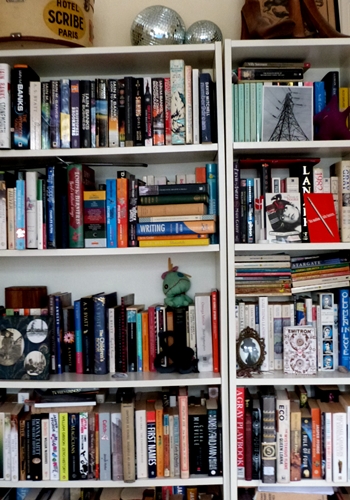
books I gave away about 80% of my books when I left Denmark and I can still see ghosts on the shelves, though I merged my collection with Dave's when we started living together. So many books.

Reading my 2006 blog posts I sounded so cavalier about culling my book collection:

"Red is for never again, never, no, it is so replaceable and it was fun but now the thrill has gone

Yellow is for what a lovely edition, I’ll never find it again and my library wouldn’t be complete without it.

Green is for of course, without a question, it’s part of me and good memories of dear ones.

I may not have a driver’s license but I have many books. I’m putting tiny stickers on their backs: red, yellow, green. So far at least 100 books have been marked with red: Borges*, Jonathan Safran Foer, Ian McEwan, DH Lawrence*, Jane Austen, Thomas Mann* and, er, Marion Zimmer Bradley. The yellow category is the difficult one. Which of Margaret Atwood’s works are yellow and not green? Should I put a bright yellow sticker on John Ruskin or is that a red (because I’m sure there’s a nicer edition out there)?

As I go through my books I realise I’m a flirty reader. I pick up books, break their hearts & spines and drop them cruelly. So many books I never finished: Anita Brookner, Iris Murdoch, James Kelman, Samuel Butler and John Barth. I’m so sorry but it’s not you, it’s me.

And the green books. My friends, my family. Alasdair Gray, Jonathan Coe, AS Byatt, John Donne, Vladimir Nabokov, Philip Pullman, Ezra Pound and EM Forster. I pet you gently and remember when I first encountered you. You are in my blood. You are going nowhere.

*victims of the bad edition rule"

And so we're back to 2014. Still so many books and they are not alphabetised. Fret.

Speaking of books, I am currently reading David W. Anthony's The Horse, the Wheel, and Language: How Bronze-Age Riders from the Eurasian Steppes Shaped the Modern World. It's an interesting look at the Proto-Indo-European language (the ur-language that spawned English, Greek, Hindi, Russian etc) and how PIE is reconstructed following linguistic rules. Anthony also looks at words and concepts that are found throughout the descendants of PIE. Words relating to wagons and wheels, certain types of animals and - relevant to my working life - textiles.

Anthony traces the possible origin* of the word wool - *HwlHn- as PIE contains roots for sheep, ewe, ram and lamb. He argues convincingly that these linguistic fragments point to a domestication of sheep. He also looks at archaeological evidence from Uruk that indicates sheep began being bred for their wool around 3350 BCE. The book then follows the linguistic fragments as they start to spread across the PIE areas. *HwlHn shatters into *Hwel- or *Hwol- .. but the word fragment doesn't always mean "wool". Sometimes it means "to felt", "something made of felt/wool", "to press" or "to weave". Anthony even looks briefly at whorls and spindles. Most of the book is devoted to horses and wheels (as the title indicates) but I did enjoy the dip into textiles. I'm now settling into a section on Neolithic farming in the Caucasus. As you do.

PS. Lots of people have posted pictures of their bookshelves (shelfies?). Do join in!
Tutorial: Creating a Magazine Submission

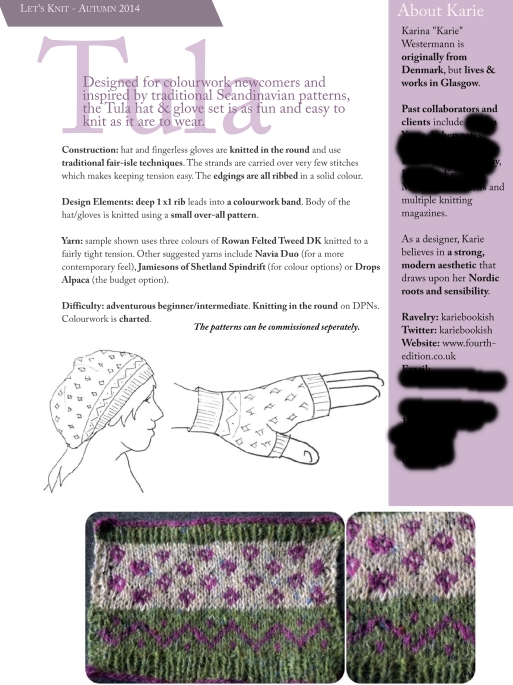
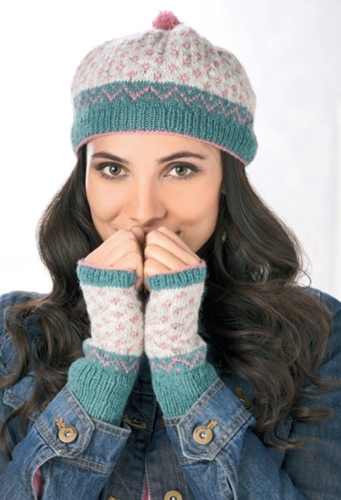
Last year I was lucky enough to get a glimpse into how Sarah Hatton curated The Knit Generation for Quail Publishing and Rowan Yarns. I have also recently helped curate a collection for a knitting company and worked closely with a couple of editors on a sub call. So, in light of all that, I thought it might be interesting to show you one of my successful submissions and discuss in detail how I put together a magazine sub. I don't pretend to have all the answers, of course, but hopefully my experience will be of some help. Recently my Tula hat & gloves set made the cover of UK knitting magazine Let's Knit. The set looks like this (photo courtesy of Let's Knit): karie hat #1

Now let's look at my original submission to the magazine.

tula

Let's dissect the sub.

tula-crop1-2

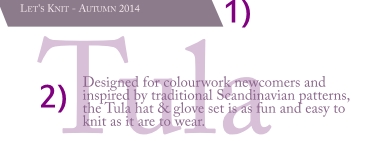
1) I personalised the sub by adding the name of the magazine. Occasionally magazines will give you "stories" or moodboards they want you to use. If that's the case, I will usually add the name of the relevant moodboard to signal that I have thought about my design in a particular context. Let's Knit didn't give me a moodboard to work from, just general guidelines.

2) The name is short, easy to spell and relevant.  I wrote a brief note about the design/design inspiration. I always try to do this in one or two sentences. This brief note should tell the editor(s) exactly what they are looking at.

Next, the details that tell the editors I have thought through the design and who it will appeal to.

tula-crop-3-6

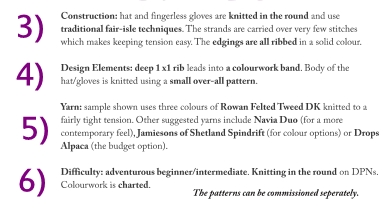
3) The section on construction is very important to tech editors. They will look at whether the designer has thought through the actual making of the piece(s). Nobody wants to commission a piece which the designer realises is impossible to make three weeks before deadline.

4) Depending upon the type of swatch and my lead-in sentences (2), I sometimes skip the design elements. However, it is useful to give an actual description of the piece(s) and this will help the editors when writing about the piece in the magazine as they may not have photos of the item handy when they write about them.

5) The yarn suggestion section is often really fun to compile, but I make sure the yarn suggestions are a) available in the country of the publication, b) they are current yarns and c) they are relevant to the actual project (i.e. not just stuff I think it'd be fun to use). My Tula swatch was knitted in Rowan Felted Tweed which has beautiful drape and comes in 29 colours. It is a sportweight which meant I could actually dip into 4ply or light DK when  it came to making substitutions. I selected Jamiesons of Shetland Spindrift (4ply) and Drops Alpaca (sportweight) as possible substitutions - both have beautiful drape and great colour ranges. Let's Knit loved my idea of using Jamiesons - and I loved using it. Note that I am not making any colour suggestions! The editors often work to colour stories and will liaise with me to make sure my design fits into their stories.

6) Difficulty level simply shows that I have considered who might want to knit my design. Tula is charted and is knitted in the round - this coupled with gentle colourwork says that it will not appeal to absolute beginners but may be an aspirational knit for adventurous beginners or intermediate-level knitters. Again, I am also considering the publication and its target audience. Knitters are not a homogeneous bunch nor are magazines!

tula-crop7

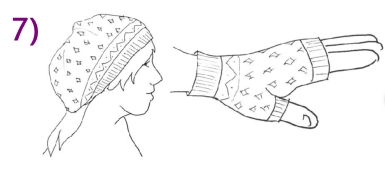
7) Sketch of fit. I want this to show how the hat sits on the head of the wearer and the shape of the fingerless mitts. I know sketching is hard for some people, but you can trace fashion models (like this tutorial tells you) and there are many free tracing models out there.  The more you practice, the better you will get. Remember: if doesn't matter if your model only has three fingers and she squints if your sketch communicates how a hat fits!

tula-crop8

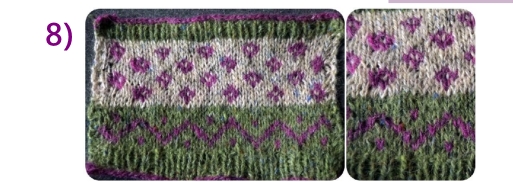
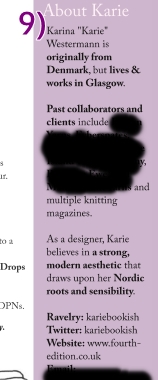
8) However, the swatch is very, very important. The swatch is where the entire story is told, really. My swatch needs to be relatively big (4" by 4" or preferably bigger), blocked, and incorporating all the important elements. Here you can see Tula's one-row cast-on and cast-off in a contrast colour, the 1x1 rib and both colourwork patterns (and how they call back to each other). The photo was taken in daylight near a window (so all details are clear) and I photographed the swatch on a neutral background. Sometimes I take a series of photos of details like beading or a particular stitch pattern and I put them next to the main photo - but only if they are important to the story. tula-crop9a 9) Finally, the bit where I tell editors about me. Quick intro to my background, a paragraph about clients and collaborators, a note about my personal design aesthetic, and finally how the editors can get hold of me including my home address so the editors can send me yarrrrn.The design is way more important than me, so I'm in the margins!
(I know not everybody has a portfolio full of client and collaborators - but I think of the Ravelry project page as an online portfolio (I got my first big break in the knitting industry after someone had seen my project page, actually) and I always check out what people have been knitting. Someone may not have many designs to their names but they may have a project page full of stunning work where they reveal a real sense of colour.)

I spell-check before turning my single A4 page into a PDF (I don't want to write nkitting and nedles - tech editors will worry I cannot format a pattern!). Note that I have chosen to use colours in my layout - I change these colours for every sub I compile so they reflect the colours used in my swatch. Partly it's because I am OCD about colour but also partly because my choice of colour/layout is part of the story I am telling with my sub. You can also see I choose to semi-bold keywords which makes life easier for a busy editor.

And there you have it - the sub I compiled for Tula. I hope this has been useful in showing you just how much information I try to  include and how I try to make the editors' decision-making easier. This is definitely not the only or right way of making a submission - remember you want to be telling your own story in your own voice!

However, if you have any questions, please do ask and I'll compile/answer them in a future post.

Trekking Through A Landscape, Gathering Sunlight: An Interview with Sarah

The other day I wrote about the dark side of the internet. Today I'm showcasing just how the internet enables us to connect with like-minded people in far-flung places. Meet Sarah. Sarah  is one of the brains behind the podcast Fiber Trek. We share similar preoccupations with knitting, landscape and history. I've been preoccupied by those themes for a long time and it is exciting to see someone on the other side of the world exploring the same thoughts.

n1516421661_30201446_7986367

How did you get the idea for Fiber Trek? It is not your standard postcast, is it?

It's not really a personal account of my life & knitting  -  more a chance to chat about what people, landscapes & animals are doing in the textiles realm. The podcast includes my friend Morgan who does a segment where we talk about ecology & natural history in a way it relates to textiles.  On alternate weeks I offer up a Textiles in Time segment which looks at topics in history.

You think a lot about fibre arts, landscapes and history. How do those interest influence how you engage with your crafts? Do you see your crafting as a continuation of a tradition?
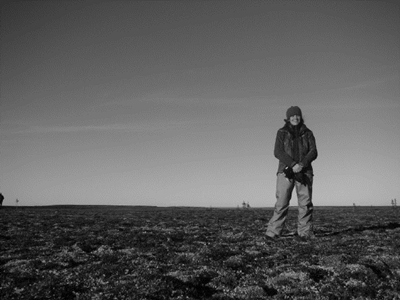
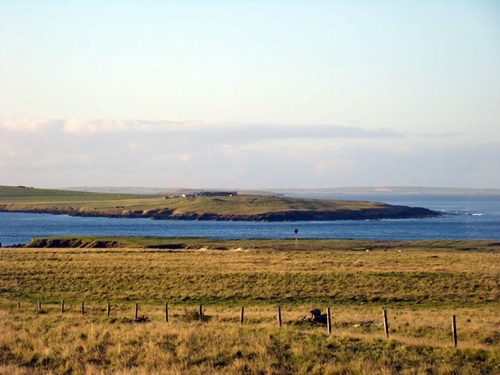
Landscape, history and tradition all have a strong influence on me.  My initial introduction was on a sheep farm in Orkney where I shepherded. I wanted to "feel" that space everyday and fiber arts enabled me to do that.  Wool encompasses the heart of the craft, the soul of the medium. When we select the yarn we touch the essence of hard work, death, birth .. the cycle.  I have become quite particular over the past year as to what yarn I purchase, not for any other reason than I want to connect with the heart and soul of my craft. I want to pick up my project and feel the farm; every stitch I take I want to have soul.The concept of time and place is so poignant. One of the best examples is Imperial Yarn and an interview I heard with Jeanne Carver on the Yarniacs Podcast.  She draws beautiful connections between the fiber and the land - and describes the sheep as a conduit through which we can harvest sunlight. I was inspired by Jeanne's commitment to landscape, her knowledge of place, and her allegiance to something greater. I love the idea of harvesting sunlight. I like it so much that from now on instead of stashing yarn & fiber, I will be gathering sunlight.

Jack and Sheep

Yes, I love that idea of gathering sunlight too. It's such a powerful image. But a big part of being a 21st century knitter seems all about coveting yarns from far-flung corners of the world. I cannot see you doing that. If you were to talk to me about local-to-you yarns, what would those be?

I love sourcing the product, squirrelling out the small farm and carrying something home that grounds me in the landscape; that allows me to tell a story every time I see it, wear it or use it. But local-to-me yarns is a difficult concept.  I have been involved in the local food movement for a long time but yarn seems to push boundaries. Yarn's not necessarily about a specific proximity to myself but it is about people and landscape - and what they are doing in that landscape. I seek out yarns in my state but I also use fiber & yarn to "travel" and support producers across the globe.  I like to research  farm-specific & artisan yarns.  I love yarns that have a story, it makes them feel "local" to me and creates a greater connection.

I am drawn to natural colors and  I like rugged yarns & fibers with toothy structure and resilience. I often look for breed-specific yarns as well as interesting local crosses.  I enjoy finding & meeting local dyers - especially those who raise or source their fleeces themselves.

Big Thumbs Up for yarns with resilience and structure. I call them rustic (which has its own landscape connotations) but I like resilience better. Speaking of place, where can people find you? 

Right now you can find me on Ravelry as Swenstea, on Instagram as fibertrektv, on Twitter as fibertrek and we have a group on Ravelry, Fiber Trek. Our blog site is http://fibertrek.wordpress.com & our website is http://fibertrektv.com

Thank you Sarah!

Fiber Trek is currently hosting a KAL for my Vedbaek shawl which I find so apt - the shawl pattern is a response to a particular landscape and a particular time whilst still being about rooting you in your time and place. I do not normally discount the Doggerland patterns, but I have given Sarah a discount code to use during the KAL. You get 20% off the pattern if you buy via the Fiber Trek KAL (check out the podcast for more details). I'm getting ready for the last Doggerland release and finding Fibre Trek is such a timely reminder of all the things I love about fibre arts.
Fersness
All photos in this post thanks to Fiber Trek

Workshops & Events Updated

July 2014 285 Just a tiny heads-up that I have overhauled the Workshops & Events page, so you can actually see where I am teaching!

Right now my Autumn 2014 schedule looks like this:

August 23: I am teaching a half-day class on Crochet for Beginners at The Queen of Purls, Glasgow.  More information here.

August 30: I am teaching a full day of Knitting Lace Shawls at Fluph, Dundee. More information here.

September 13: It's a return to Dundee as I'll be running my two-handed colourwork workshop (Full Day) at Fluph. More information here.

September 27: Learn how to design your own lace projects with me at this half-day workshop at The Queen of Purls, Glasgow. More information here.

October 12: I'm teaching Two-Handed Colourwork (Full Day) at Be Inspired, Edinburgh. More information to come here.

October 25: I'm back at Be Inspired, Edinburgh, for a half-day class on how to tackle short-row shaping in lace. More information to come here.

November 1: An introduction to two-handed colourwork (Half Day) at The Queen of Purls, Glasgow. More information here.

November 9: I'm running a full day workshop on Crochet for Knitters at Be Inspired Fibres, Edinburgh. This class covers the basic crochet techniques before exploring how knitters can use crochet and knitting together. More information to come here.

Several 2015 dates are already in place, so start looking out for those towards the end of this year.

Thanks to an awful knee injury I was unable to teach workshops at the beginning of this year, so I am really looking forward to getting on the road to meet knitters again. It's slightly unusual for me to teach this much, but it feels really nice too. Invigorating, that's the right word. Nothing beats seeing people being all happy about a new skill or idea.

(Psst.. If you are a yarn shop, a knitting festival or a retreat, please use the form on this page to get in touch)

A Little Bit About Designing

July 2014 845 Summer is always one of the busiest periods of my working life as magazines are commissioning items for their autumn/winter issues. I have just finished the last of my many commissions and am now looking forward to getting stuck into the self-publishing side of my life. I have been asked many times how I go about doing what I do, so here's a little run-down.
  • I start by compiling a moodboard (this is my moodboard for a mini-collection I did together with Old Maiden Aunt yarns). As I add pins, a theme will eventually emerge and I start editing the moodboard down to the bare minimum of pins I need to convey the idea.
  • I sketch ideas based upon the moodboard. This can be anything from stitch pattern ideas to the shape of a sleeve or even the actual piece I want to design.
  • The stitch pattern is charted and I start pondering things like what sort of ribbing I'd use or what type of drape I'd require from the yarn.
  • I decide upon yarn and swatch. I always knit a generous swatch (at least 6" x 6") and I wash & block my swatch.
  • Basing my numbers upon my swatch, I then write the pattern. Numbers are everything. Before I have cast on a single stitch, I will worked the entire piece in my head and on paper.
  • And then I cast on.

There are many ways of going about designing, and I always advocate doing what feels right and natural to you. However, by working out the entire pattern before I commit to knitting it, I reduce the risk of having to rip back because the numbers do not add up and, of course, the risk of forgetting to take notes.

I'll write more about my design process later this year when I'll show you my sketches and swatches for a garment that is due to be published around November.

I talk more about my working life, my sources of inspiration and my plans for the future in this interview I did with the lovely folks of Love Knitting. The interview took place just after I returned from Unwind Brighton so I am pleasantly surprised by how coherent I sound!

Speaking of Unwind Brighton, my head is buzzing with ideas and plans.. and I finally have time to sit down and do something about all the things in my head. Huzzah!

Knit Works - A Weekend of Creativity & Scandinavian Love

July 2014 407 Being of Nordic persuasion, it was perhaps inevitable that I ended up working at Knit Works in Edinburgh this past weekend.
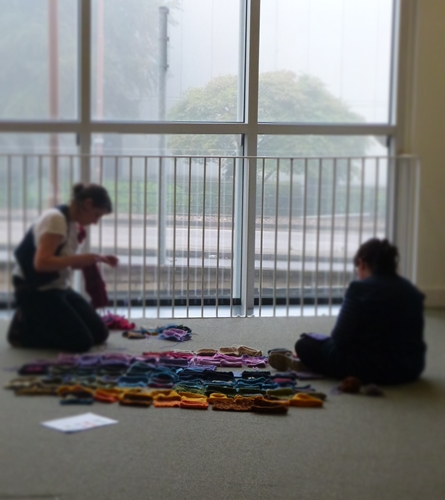
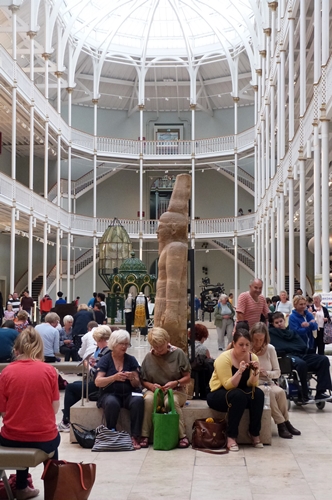
Knit Works was a collaboration between the National Museum of Scotland, The Danish Cultural Institute, Edinburgh Fashion Festival and local yarn shop McAree Brothers with Rowan Yarns donating a sizeable amount of yarn to the event. I helped supervise and cheerlead a staggering amount of knitters as they worked on a collaborative project celebrating Scottish and Nordic knitting culture. Although it was a very busy weekend, Knit Works was also a nice change of pace for me. I had spent the previous weekend working at Unwind Brighton and I could not help but marvel at the differences between the two events.

I think we talk a lot about the knitting community - making it sound as though it is a monolithic, homogeneous entity with similar tastes, attitudes, and interests. I would suggest it is better to talk about the knitting communities as knitters are very diverse with very different approaches to knitting, tastes and lifestyles.

While Unwind was very much about physically consolidating a pre-existing online community, Knit Works felt like giving various communities the chance to meet however briefly. It attracted a lot of knitters who were seasoned knitters-in-public, who wielded charts with ease, and who were comfortable going off script. Being in the middle of the National Museum, it also caught the attention of tourists: people who were unused to following English-languaged instructions, people who knew how to knit a little and people who were just excited to get into crafts for ten minutes. We also got a lot of people who were seasoned knitters but had never knitted in public before, people who discovered the pleasure of meeting other knitters, and people who found it a challenge to talk and knit at the same time. I found it incredibly interesting to watch this merging of communities and seeing people finding common ground through knitting.

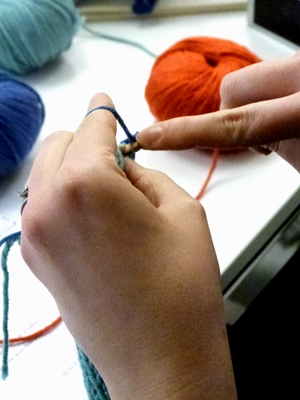
(I will never tire of watching knitters' hands work, incidentally.)

July 2014 606Carol Meldrum, Heather Peterson and I worked out a design based upon the squares knitters had handed in on the day. Originally the plan had been to have a giant Norwegian-style snowflake on a neutral background. We received so many colourful, vibrant, and interesting squares that we revised the plan significantly.

Instead we devised a colourwash design (I was briefly accused of having colour OCD, thank you Carol) which allowed a lot of beautiful squares to shine. We also had a pile of swatches donated to us by the machine knitting girls from Brora, pom poms were donated by kids who had been yarn-bombing the museum, and we were given pretty crochet squares from an Arne & Carlos workshop (totally hyggelige guys in that very special Scandinavian way).

Within ten hours of starting we went from a pile of yarn to a big, colourful blanket that will be touring Scotland over the next few months. It helps when you have a lot of happy knitters on hand to help you. I found it really nice to spend time among Scandinavians (we had a good turn-out of those, tak!) and just chill out with knitting for once.

However, after the last two weeks, I am seriously shattered. I'm a textbook introvert and the next few days will be spent recharging my batteries. As much as I love meeting knitters & getting all excited about making other people excited, I'm going to enjoy my own company and some blessed solitude with a dash of knitting. Hopefully it will rain.

Ahhhh...