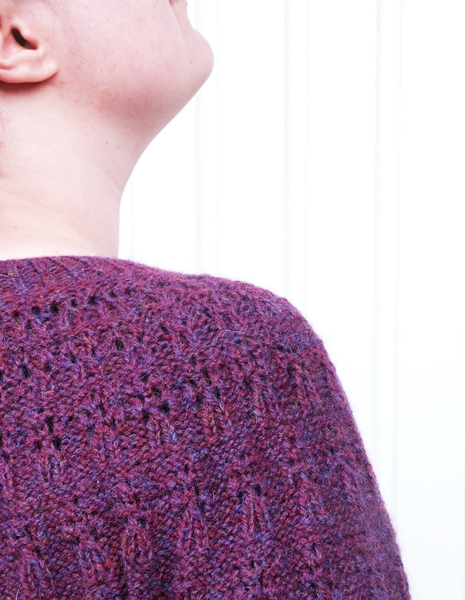
I have been collaborating with my good friend, the marvellous Susan Crawford, and Noblesse Oblige is my contribution to her "Knits in a Cold Climate" collection.

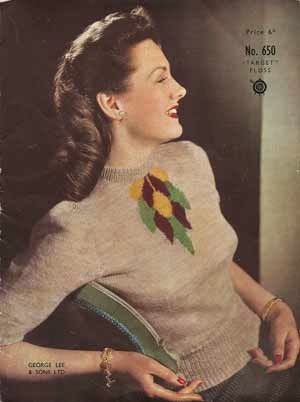
When I was given the design brief by Susan, I knew I wanted to use the wonderful colour range in Susan Crawford Fenella. Inspired by my recent forays into knitting archives, I began sketching Fair Isle bands but it was not until I uncovered a photo of a 1930s knitting pattern that I decided upon the colour scheme. The jumper is charming, but I fell in love with the red/green/yellow motif. Could I use these colours in a more traditional setting?
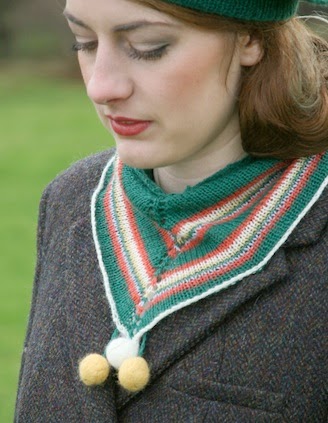
After several attempts, I hit upon a 1930s inspired hat and scarf using that red/green/yellow combination, but also tempered by a soft porcelain blue and a delightful creamy white. The jaunty beret features two Fair Isle bands that counteract each other to create a sense of dynamism.
The scarf comes in three sizes - you can make it a neckerchief, a small scarf or a full-sized shawl. To optimise knitting pleasure, the scarf does not use Fair Isle bands but features narrow stripes in a colour sequence that calls back to the beret. After much discussion, Susan and I agreed that small, felted pompoms would add a delightful finishing touch.
Naming the pattern was harder. I wanted to use one of Nancy Mitford's book titles, but neither Christmas Pudding nor Pigeon Pie seemed appropriate! Finally, Noblesse Oblige seemed to suggest itself - it is a collection of essays and I rather enjoyed Nancy Mitford's essay on the English language. So, Noblesse Oblige. A lovely hat and scarf set. I hope you will enjoy knitting it.
But let's talk about Nancy Mitford's essay briefly.
Found in Noblesse Oblige, "The English Aristocracy" is her most famous essay. Nancy Mitford had recently read an academic article by a British linguist and was inspired to write her own examination of how the British upper class ("U") and the middle class ("non-U") spoke. The essay is very much of its time - apparently only non-U people would speak of telephones! - but that is also part of its appeal. It is a snapshot of a world in transition where old notions of class and importance are slowly eroding. It is particularly interesting to compare Mitford's essay to Grayson Perry's TV documentaries about Class in Britain. The economic barriers between the classes may have eroded, but cultural markers such as language and taste have not.
"The English Aristocracy" is an early example of what we know today as sociolinguistics. A "sociolect" is a type of language associated with one socioeconomic class, age group or gender. The British 1990s sit-com Keeping Up Appearances uses Mitford's little U vs non-U markers and sociolects to great comic effect. The main protagonist, Hyacinth Bucket, insists her surname is pronounced Bouquet, and she keeps grasping at big, fancy words in her attempt to sound more refined (something Mitford notes is the true mark of a social climber - why use the word "lavatory" when "loo" is perfectly adequate?). The underlying class anxiety so evident in Mitford's 1950s essay is very much visible even forty and fifty years on.
If you have half an hour to spare, I suggest you read Mitford's little essay in Noblesse Oblige - I assure you that you will notice amusing little things about how you and the people around you speak.
Now for the important pattern details: you can buy the pattern from Ravelry here. It is £4 and the pattern uses five shades of Fenella. Susan is planning on offering a kit which you will be able to buy from her shop.
It has been marvellous working with Susan on this pattern - she understands my shorthand descriptions so very, very well and has an incredible eye for details, style, and colour. I also really enjoyed working with Fenella which has a such lovely bounce in its step.

 For the past eight years or so, we've enjoyed a surge in quality indie designers offering amazing patterns for us to download. A digital revolution has changed crafting completely: knitters (and crocheters) came out as the winners because we suddenly had all these fantastic designers at our disposal with just one click of a button. From Ysolda Teague & Stephen West to Kate Davies & Gudrun Johnston, many designers started with a single pattern and gradually started growing as designers and businesses. I don't know if you know, but the knitting & crochet community is going through a bit of a sea-change at the minute. Making that same journey is going to be awfully hard in years to come and the real losers are the knitters and crocheters.
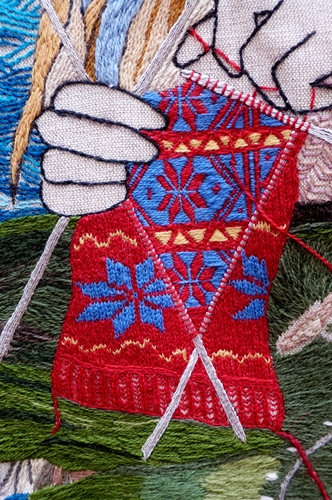 Folks, there are going to be some changes around here.
My work/life balance has been seriously dysfunctional for some time and I am feeling the toll. In order to avoid burning out and crashing out of my job, I'm simply going to make some changes to how I offer support. I am very sorry. I love hearing from you guys - I really, really do and I hope you know this - but I also need time to design and write stuff.
Folks, there are going to be some changes around here.
My work/life balance has been seriously dysfunctional for some time and I am feeling the toll. In order to avoid burning out and crashing out of my job, I'm simply going to make some changes to how I offer support. I am very sorry. I love hearing from you guys - I really, really do and I hope you know this - but I also need time to design and write stuff.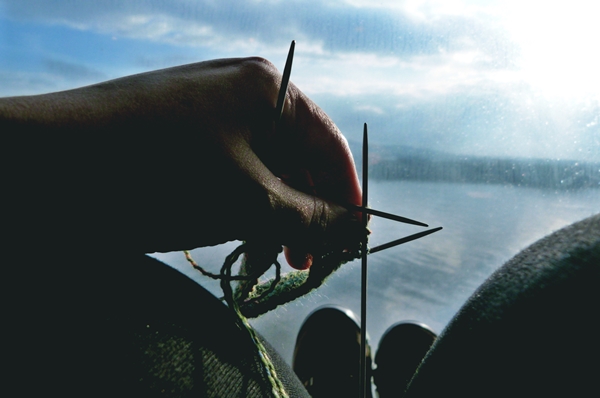 I love travelling on ferries. I suppose I could blame my Viking blood, but I have always found sailing immensely enjoyable and relaxing. Last week I visited Northern Ireland for the first time which meant a long ferry ride across the Irish Sea as well as a long bus journey through the Scottish Lowlands. The journey home was especially lovely as the sun was out and I found myself a window seat where I could knit away and watch the waves without getting disturbed. Utter bliss.
 2014 turns out to be the year where I break free from all the ..but surely I can't .. whispers at the back of my head. I am fully self-employed, I have been part of all sorts of incredible craft events with properly big knitting names, and now I've released my first garment pattern. Designing garments always felt daunting because they have to fit across sizes, there are all sorts of things to keep track off, and (crucially) they have to fit people other than me.
So, say hello to
2014 turns out to be the year where I break free from all the ..but surely I can't .. whispers at the back of my head. I am fully self-employed, I have been part of all sorts of incredible craft events with properly big knitting names, and now I've released my first garment pattern. Designing garments always felt daunting because they have to fit across sizes, there are all sorts of things to keep track off, and (crucially) they have to fit people other than me.
So, say hello to