
Homebound: Who We Are

Homebound 6Homebound: Who We Are is my knitted artwork currently on show at Glasgow's Tramway Arts Centre. Using site-specific materials I have created a piece asking how we understand ourselves, how we become who we are, and how big a part gender & geography play.

I was inspired to make this piece by my own journey as a knitter, as a woman, and as an immigrant. I am myself but I am also previous generations of ordinary women crafters. My mother, my grandmother, my great-grandmother and my great-great-grandmother are all represented by this piece.

Homebound 1

It was important to me that I only used yarn I already owned and which was tied to specific geographical areas. I used yarn from a farm just a few miles from where my great-great-grandmother lived. I used yarn from the Faroe Islands because my paternal grandmother is Faroese. I used yarn spun locally to Glasgow because I live here now.

I used undyed Aberdeenshire yarn for the hand. I have family living in Aberdeenshire now and I wanted to include them in the piece.

The hand is very significant to me - and my partner helped me construct the hand, so he is included in this piece too - as it is the giver and holder of identity. Not only does it hold all the strands together but the strands also spring from the hand. As a crafter I make things with my hands; my hands turn ideas in my head into reality. People much cleverer than I would be able to tell you about the notion of creation. The hand holds that concept for me.

Homebound 5As you can see, photos are included. I have found photos of all five generations.

As I was looking through the photo albums I was struck by how gender-segregated my family seemed. The women were all pictured holding babies or wearing nice dresses or cooking. The men were all pictured sitting at tables drinking beers or playing football or standing next to cars. I rarely found pictures of women and men together - except wedding photos or pictures of couples dancing.

I found several photos of both women and men wearing knitwear. I could only find two photos of anyone knitting. One of them was of me.

Finally, the title. I chose Homebound because while it means two mutually exclusive things (travelling//constriction) my project suggests there is an additional meaning lurking within the word, a meaning linked to the notion of creating. Home-bound – to bind or to tie or to make within the home.

I am really excited about this piece and I want to thank the people behind Loop: Garterstitch100 for giving me the opportunity to be a part of their amazing event. It has been an incredible journey for everyone concerned - me included.

Knitting Difficulty (Teal Deer Territory)

Recently Ms Orata wrote a really fascinating post about knitting and how knitters/crocheters perceive "difficulty". The post is fantastic and I recommend you read it because she deals with the concept of "difficulty" in astonishing details. Read the comments too. Good stuff. (Note: I have no real agenda for this post - except I deal with a high number of knitters and crocheters of all abilities on a daily basis. In the following post I refer a lot to "knitters" but I mean "knitters + crocheters" really.)

I see people struggle with garterstitch scarves, I see people executing complicated lace with ease. I see people measuring their skill level by how many years they have knitted; I see people measuring their skill level by how many different types of projects they have knitted. Each knitter have their own concept of  what "difficult" means. Interestingly each knitter also has their own concept of what "a good knitter" is and it rarely matches their own ability: most often people underestimate their own ability although I have met some (very, very) rare cases of astounding arrogance. Underestimating your ability may well be a gender thing.

(As an aside: most of the knitters I meet are not on Ravelry and most do not care to be. In my experience Ravelry users tend to be more advanced knitters simply because they are so interested in knitting that they will join a social media site dedicated to knitting. To reiterate:  in my experience Ravelry users are the anomaly, not the norm, when it comes to skill sets. To use Ravelry numbers as the basis of analysing the concept of 'difficulty' within knitting is to automatically distort numbers. Finding more accurate figures is a different problem altogether.)

It has been said many times that you only need to learn how to do a knit stitch and a purl stitch and you can knit anything. Not true. You need to know how to cast on and -off too. You need to learn the trick of reading a ballband to determine needle size. You need to wise up to pattern terminology. This is very, very basic knitting and arguably you will soon need to learn increases and decreases. UK yarn company Sirdar even had short row shaping in one of their 'easy knits' patterns recently.

In recent years I have come to regard myself as an above-average knitter. I can follow patterns (even bad ones) and have written some basic ones myself. I can fudge things and devise short-cuts if I please. I can do pretty complicated stitch patterns (and teach you these) without breaking sweat. I have shortcomings, of course, as I'm not great at intarsia and I'm lazy enough to stick to a few cast-ons and cast-offs rather than teach myself more. But I'm actually pretty good. I cannot use my own knitting ability as a yardstick, in other words.

What is "difficult"? I'll use two recent examples.

Example 1) I recently had to figure out how to construct a cowl which has you knitting strips which you then twist into knotlike structures before beginning a simple cable pattern. The knitting itself wasn't complicated but the sculptural construction was unlike anything I had ever seen.

Example 2) My next project uses an Estonian stitch pattern which I have had to use a few hours of swatching to 'crack'. Once you understand your eight-row repeat, the actual garment construction is very simple. I'll have more on this project later this week - including my swatches and a look at how to understand the stitch pattern.

My two examples are both difficult but they are different types of difficulty.

I would say that even an advanced beginner could make my first example but it would need to be an advanced beginner with specific non-knitting skill sets in following a technical manual (anyone with IKEA assembly experience, essentially).

The second example I would not recommend to knitters below a certain level of expertise. The stitch pattern is straightforward - but only if you have a certain amount of patience, guts and experience. You need to be comfortable with lace (out of the eight-row repeat you have two rest rows and they are not even purl rows), you need to be happy with dropping stitches seemingly randomly, you need to be able to read your knitting (the pattern lines up logically but you cannot tell from the instructions), you need to be willing to go beyond your regular knit/purl/yarnover/decrease lace knitting, and you need to accept that tinkering back will be a beast (as you are using Kidsilk Haze). Phew.

Interestingly both these examples have been labelled "intermediate" by the yarn company. I'm glad it is not my job to suss out these labels; I can see why the patterns share the same label but it is a laborious path to get to that stage.

If you have made it this far, I'd love to know how you would rate your own skill level, how you select patterns, and what you consider "difficult"?

PS. teal deer.

Loop Needs You

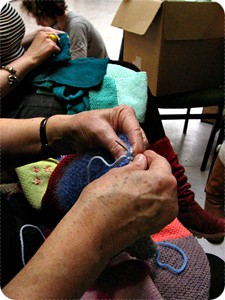
At the Tramway You may remember me mentioning Loop: The Centenary of International Women's Day - an exhibition (and celebration) taking place at Glasgow's Tramway art gallery. You may even have knitted a square or two for the event. The event takes place on Tuesday and the Tramway is heaving with activity. I spent most of Friday at the Tramway stitching together blanket squares. It was a hugely inspirational day.

One old lady was busy stitching together crochet squares but found time to sing us old Glasgow songs from her childhood - songs about the old Govan cinema and "oor baldy heided maister". Women from a choir sang us Matt McGinn songs. Women from a local immigrant group came by to watch us stitch and some ended up wanting to join in despite initial shyness. Later a cellist started playing Bach.

Generations of women showed up - grandmothers with their grandchildren; mothers with their children. Many different nationalities were there. Many different parts of Scotland were represented. Even a few brave men showed up to stitch - my partner was one of them and he proved very adept with a needle and thread! I was rather proud..

At the TramwayHowever, help is still needed.

You do not have to be greatly skilled with a needle of thread. You do not even have to know how to thread a needle as plenty of of volunteers will be on hand to show you the ropes.

If you can spare thirty minutes of your day (or more!), please come down to the Tramway tomorrow between 10am and 11pm.

You won't regret it. You will meet some truly inspirational people with wonderful stories to tell, you'll be surrounded by beautiful art, and your help will be hugely appreciated.

I will continue to be busy these next few days, but thankfully I have a few blog posts in hand so stay tuned..


Made

After several weeks and a marathon day today, I have weaved in the last ends of Homebound - Who We Are which I am exhibiting at Tramway (artistic nudity - possibly NSFW - them - not me!) next week. I will write more about my actual piece and take plenty of photos once the exhibition opens, but right now I'm just rather happy to have finished making it. Today has been a ten-hour odyssey of adding-editing-adding-editing and some more editing (I'm a big fan of less is more).

Leisure knitting, sewing, and blogging are all on the agenda for the next few days. I have signed up for a quilting course alongside some familiar faces which should be fun (although the quilting tutor might not agree after being subjected to us!). I have been practising the lace pattern for Fancy and I think I have cracked the secret code. I also have a halfway-done muslin for my Simplicity 2501 top which I am itching to finish..

.. maybe I shall start by having a quiet night off from making things.