Personal

Seasonal Greetings

Merry Yuletide!

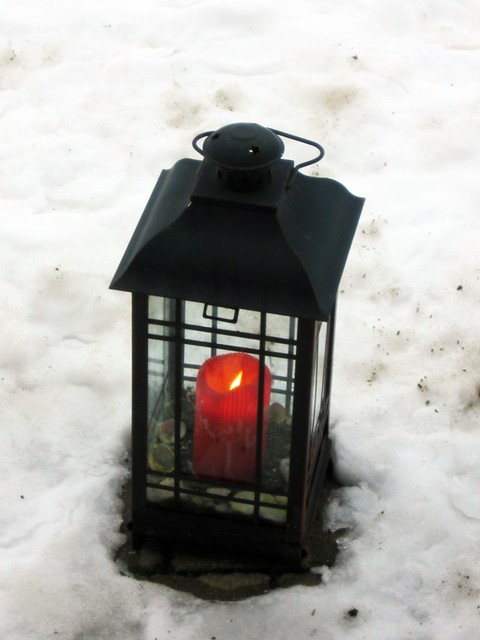
The days are finally getting longer. We may be heading into deep winter, but light is returning to the Northern hemisphere. This year I have been enormously homesick - yearning for a traditional Scandinavian jul with its baked goods, traditional singing, and blazing candles. While I have been too busy to do much baking myself (and singing is no fun on my own), I have kept candles going throughout the month. And now we turn the corner.

Glædelig jul - happy holidays - to you all. Here's a bit of 1950s Danish jule-kitsch.

2012: My Year in Knitting

I'll start by telling the truth: 2011 was a tough year for me. I ended it feeling I had lost track of who I was and where I was going. And so I began 2012 vowing I needed to spend more time doing things I love doing rather than doing things I thought I ought to be doing.

Pub Knitting

This is what I wrote at the end of 2011:

  • I’m already working on more patterns. I have sketchbook filled with what is essentially 2-and-a-half collections worth of patterns. Hopefully I will be able to devote more time to this in 2012.

Tick.

  • I’d really love to knit a few garments in 2012. Quality over quantity.

Not really, but I'll write more about that in a future blog post.

  • And I still need more hats.

Moths did their best to destroy my hat collection so I did knit myself a handful of hats. I still need more. Cannot have too many hats.

  • Keeping on top of the stash. I cannot promise ‘more yarn out than in’ but at least I won’t do the ‘oh, I fancy a ball of that’ thing because that way madness lies. I am getting far better at curating my stash already. May it continue.

I was much better at resisting temptation in 2012. I still added to the stash but I did so in a thoughtful way. I bought very little yarn (and only yarn I needed for specific projects) and I turned down offers & gifts of yarn.

  • More conscious allocation of my knitting time: what is ‘work’ knitting and what is ‘me’ knitting?

Definitely.

2012 has been an interesting year. I did stick to my nebulous plan of "doing things I love doing" and it worked out pretty well.

Handmade Living feature

I can roughly divide my 2012 knitting into two piles:  a bit of knitting for friends..

.. and a lot of knitting for work:

I feel tired just looking at that. I also felt rather tired of my own voice at one point, but that's something for the 2013 list!

STV

I feel like I didn't do much personal knitting in 2012.  I finished a shrug, frogged a couple of half-done garments and began knitting Acer and Bute. Both are still on the needles. But I cleared my head of all the oughts and that counts for a lot.

A couple of links to patterns and books I coveted this past year. A massive amount of good stuff seems to have come from the British Isles this year!

And I loved listening to the following podcasts (among so many others):

Also a few fist bumps to the following yarn vendors/pushers:

Phew! I think that was it. What a crazy, marvellous year.

April 2012

The Kirkja Shawl

June 2012 780
June 2012 780

And then I designed a shawl and it appeared in Knit Now. Okay, things are never quite that simple. Earlier this year I was exchanging ideas with Knit Now magazine, a UK knitting magazine focused on accessories and keen on showcasing British design. The editors were doing an issue on "heritage" and when I mentioned I was part Faroese, the end result was the Kirkja shawl.

The sample is knitted in Old Maiden Aunt 100% merino 4ply in the delicious "Buttermint" colourway (it takes just one 400 yrds skein!). I knitted the sample back in late spring, but I must somehow have known I'd need a ray of sunshine in December. Isn't it just a stunning happy colour?

I opted against a traditional Faroese shape as I wanted the shawl to be an accessible knit for intermediate knitters. No shoulder shaping or casting on several hundred stitches. Instead I chose to play with geometric patterns so familiar to Faroese knitters and showcase them in an easy triangular shawl.

It was really good working with others for a change. I tend to Wear All the Hats when I design, but I had the support of the Knit Now team during the whole Kirkja design process. It was fab seeing the finished photos from the professional photo shoot and I really enjoyed the bantering back & forth about stuff that non-designers find dull (i.e. pattern formatting & charting software).

Kirkja can be found in Knit Now issue 16 which is out with subscribers now and will be in UK shops tomorrow (December 13, 2012). Not only did it make the cover, but it also came highly commended by the editors and got a four-page spread inside the magazine.

(I'd pop champagne but I think I need some tea to warm myself up instead! It is freezing outside and our flat is cold. The glamorous life of a knitting designer!)

Knitting as Cultural Activity - Reflections 4

The LighthouseThis post is the last in a series of posts extending the talk I gave at Glasgow University as part of the Handknitted Textiles & the Economies of Craft in Scotland workshop series. I am fascinated by knitters' hands. No matter who we are - whether unsure beginners, lifestyle knitters, industry professionals, textile conservationists or artists - we all engage with the craft using our hands. We may hold the yarn in a myriad of ways and work the stitches at our own pace, but knitting is a tactile craft. The fabric is created by our hands. You can tell the difference between handknitted and machine-knitted fabric. Hand-knitted fabric holds the story of whoever made it. It has presence.
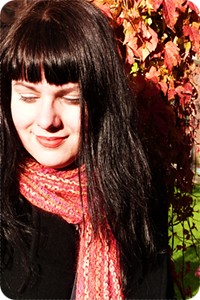
I think it is this echo of presence - the shadow of the knitter's hands - that is so alluring to textile artists.

Roxane Permar is one of the people behind the Mirrie Dancers project - a Shetland-based arts project combining traditional lace knitting with state-of-the-art technology. Shetland knitting heritage is a complex story but Permar decided to take what is often a dark story and literally shed light on it by projecting knitted lace sample onto the Mareel arts venue.The Lighthouse

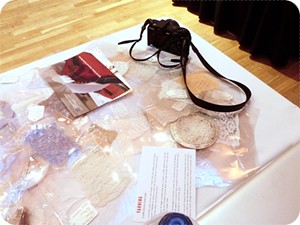
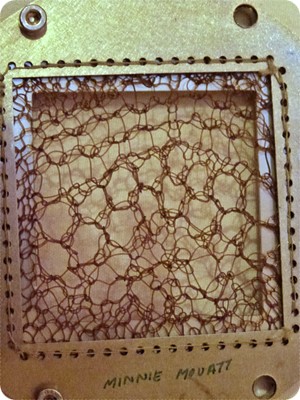
The Mirrie project involved a large team of highly skilled and dedicated Shetland lace knitters spread out across the islands who were all asked to knit a sample of lace in a heat-resistant material. The choice of material proved to be a surprising point of contention: some of the knitters refused to work in other material than fine Shetland wool. Other knitters embraced the task with surprising results - one of them started to play around in order to see how far you can take Shetland lace. Anne Euston is now pursuing a textiles degree specialising in a modern interpretation of lace knitting (you can see an example of her work on Kate Davies' blog).

I was intrigued by how far you can take lace knitting and what you can do with it. What does it look like when you project something that fine and minute up on a wall? I looked at the samples Roxane had brought with her - they were so delicate and obviously crafted with great skill and care - and yet when they were blown up, they became disembodied, abstract and strange. I no longer noticed the elegant stitches - I wondered about the holes, the gaps, and the absences caught and distorted by the light.

I thought Mirrie Dancers was incredibly successful - it made me think about the gaps and absences in how we approach about Shetland (lace) knitting today.

The Lighthouse

By for me, it always comes back to the twin ideas ofpresence and absence*.

The Material Culture students at Glasgow University learned how to knit as part of their Masters. They will go on to work in museums and as field archaeologists - and will be handling handcrafted artefacts as part of their everyday working life. Knitting, Dr Nyree Finlay argued, was a way of making them more keenly aware of both the workmanship behind the artefacts but also what it means that something is handmade.

Did they? Some of them never taught themselves to knit. One girl could cast on, but could not knit. Another could knit (but not cast on). I wondered if they had thought about the materials they used - but they had been so focused on learning the craft that they hadn't thought beyond a basic budget and colours. I don't know why but that slightly disappointed me - I get that mastering the craft was foremost in their minds, but I had hoped they would take the opportunity to also engage with the actual material circumstances of the craft.

And this is where I am left to write about how I engage with knitting as a cultural activity.

My "problem" as a designer is that I tend to start with very abstract concepts (such as Palaeolithic marine archaeology) and I have to spend a lot of time trying to parse that into a commercially viable pattern collection. The collection following Doggerland is rooted in something even more High Concept - and while my ideas are probably more suited to being explored by textile art (hat tip Deirdre Nelson!) I keep returning to my obsession with accessibility. I want to enable other people to knit my ideas and be able to wear them. I want to make meaning through knitting but simultaneously enable others to construct their own meanings and knit their own stories.

(A huge thank you to Professor Lynn Abrams and Dr Marina Moskowitz for inviting me to this series of workshops.)

* I blame myself for reading literary theory at an age when others were out partying. That sort of thing wreaks havoc.

Knitting & the Marketplace - Reflections 3

This post is one in a series of posts extending the talk I gave at Glasgow University as part of the Handknitted Textiles & the Economies of Craft in Scotland workshop series. It is no secret that I work in the knitting industry and that I wear a number of hats. When I was first approached to work within the industry, I was unsure what it would be like to turn my hobby into a job. Would I still enjoy knitting? Could I maintain a decent work/life balance? Would my knitting friends treat me differently? Would I treat knitting differently? Several years later I still do not have all the answers but right now I'd say "yes", "no", "a bit" and "somewhat".

I work in both sectors of the industry: the commercial and the independent sectors. Each sector have its own idiosyncrasies but having a firm grounding in how the commercial knitting sector works has helped me understand how I can carve out a space for myself within the independent sector and which pitfalls I should avoid. More on which later.

But first let me clarify what I mean when I talk about the "commercial" sector and the "independent" sector:

  • The "commercial" sector is mainly made up of big yarn companies with their own in-house designers, publishing houses, and established "name" designers who work extensively with subcontractors.
  • The "independent" sector is mainly made up of one-person businesses with personal creative control. This could be yarn dyers, pattern designers, yarn shop owners, workshop tutors etc.

Arguably the shift in the public perception of knitting has been led by the independent sector via social media but the ongoing success has been facilitated by the commercial sector offering easy and affordable access to patterns, yarns, workshops etc. I would actually say the two sectors are far more symbiotic than they may appear.

Furthermore, the division between the two sectors is often hard to see: is Fyberspates an indie dyer or a commercial yarn company? The lovely Sarah Hatton works as an independent but with close ties to Rowan Yarns. The sectors work together in a myriad of ways to ensure knitters a vast variety of products and experiences. I would suggest the dichotomy is illusory at best: we need to think of both sectors as being commercially viable in the marketplace. Despite what some people may think about independents (especially when it comes to our intellectual property!), we do like paying our bills as much as we love being passionate about yarn and knitting!

For me, the key point revolves around creative control. When I work within the commercial sector, I do have a small say in yarn development or pattern support but I will not see the result of my suggested changes for nearly 18 months because I am just a tiny part of a very big whole. The independent sector is much quicker to respond: I see the result of suggested changes within 18 hours - sometimes within 18 minutes.

What has the commercial sector taught me that I can apply in my indie work? Plenty of things.

  • I think in terms of "collections" now. A cohesive theme. A controlled colour palette. One underlying idea.
  • I think about the technical skill level needed to knit one of my pattern. I am probably guilty of "aiming low" when it comes to technical fireworks in my patterns but I am passionate (to the point of obsession) about the idea of accessibility.
  • Consistency in pattern writing. I've set up my own in-house style sheet so I can provide consistency in my own patterns (when writing for others, I'll use their style sheets when provided with one)
  • You are nothing without your network. Even as an indie designer with a tiny portfolio, I could not do what I do without a vast array of other people supporting me. This ranges from yarn support and test knitters to fellow designers being my sounding board and tech editors crunching my numbers.

Right now I am happy to be working within both sectors. I have had to learn on the job as I do not have a design or textile background, but I am never bored, new challenges/opportunities come knocking constantly, and I meet some incredibly interesting people. It's fair to say that people who work within this industry all have unique backgrounds and their own special stories - it's quite unlike any other industry I have ever worked in.

Addendum: I am indebted to my friend Esther Maccullum-Stewart (University of Chicester) for her definition(s)of "indie". Esther is a media reseacher with a particular interest in "indie gaming". During a conversation about online communities, we were intrigued by the many structural overlaps between the online gaming and knitting communities.

Knitting & Social Media - Reflections 2

This post is one in a series of posts extending the talk I gave at Glasgow University as part of the Handknitted Textiles & the Economies of Craft in Scotland workshop series. Ms Bookish

Social media and knitting are closely connected.

Knitting blogs gave young knitters a space to talk about their craft and enabled them to interact with each other. Ravelry is now the mothership for all online knitters nowadays: we interact in groups, we search the pattern and yarn databases, we amend database entries, we add photos of our knitting, we marvel at others' creations, and we connect.  I use Twitter much more than Ravelry these days, though. Twitter allows me to schedule things, ask/answer questions, meet interesting people, and laugh/cry - and do all these things with ruthless efficiency and a great signal-to-noise ratio.

The trouble with having a visible social media profile is that you need to perform yourself in public.

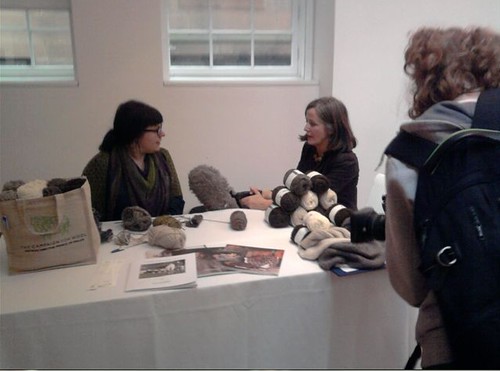
Despite my online presence, I am an introvert. I find social interaction draining and difficult. I am much more articulate when I type than when I speak. I find a roomful of strangers quite daunting. As you can imagine, working throughout Wool Week has been simultaneously incredibly inspiring and immensely draining.

Social media is a fabulous way of branding yourself. I am not a natural marketeer and I find the "B" word a mite upsetting in some respects - but I view social media in two ways: it is a great tool for connecting with people and it's a way of telling the story of your work.

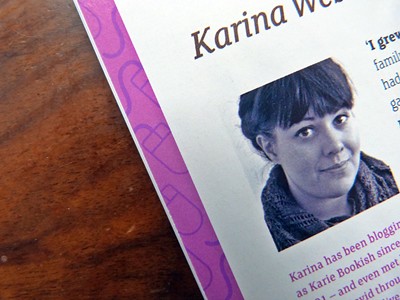
But I am tired of Karie Bookish. Let me qualify that: I am tired of performing Karie Bookish. She is me and I am her, but I am exhausted. I love knitters and I love talking about knitting (even if I have a complex relationship with the practice) but I get so very tired of myself. After fifty minutes of working my bit of Wool Week, I wanted nothing more than escape and find a sequestered place far away from all social interaction. But how could I do that when I am essentially my own brand? I can see I will need to find a strategy for coping in the future, as I am due to work more big events and I don't want to end up as burned out as I was Sunday afternoon.

(Strategies on a postcard, please).

When you are are so visibly your own brand, social media come with added responsibilities too. I have seen dozens of businesses crash and burn through ill-considered use of social media: bitching about customers, admitting to fraud, blowing off responsibilities or just coming across as very unpleasant individuals. Sometimes ignorant use of social media is worse than no use of social media: if you only tweet adverts for yourself and refrain from interaction, people will unfollow you. There is a reason why it is called social media. I tend to recommend that you set up anonymous accounts on social media sites in order to learn the relevant etiquette if you are completely new to this way of communicating - that way you do not have to worry about potential faux pas affecting your business.

Despite the many pitfalls, social media are important components in making knitting flourish. It has allowed charismatic, enthusiastic people to 'spread the gospel' of knitting not being a time-capsule craft. The new channels provide a way of interacting with other people who share your interest across the globe. Knitting is a craft that is very much alive and kicking - and thanks to social media you can find and interact with people who share your passion.

Addendum: I met a lot of fantastic people this past week - many of whom I had only met online prior to Wool Week. I was lucky enough to have a stall next to Helen of Ripplescraft at The Lighthouse - I can only recommend having Helen as your stall neighbour: she kept me sane and caffeinated. Fellow designer Joyuna and I had coffee in the middle of Glasgow on a sleepy Sunday morning - she's just made the front cover of Interweave's Jane Austen Knits 2012! And I met with book artist Josie Moore following Friday's Glasgow University workshop. I took great pleasure in discussing William Morris over cream tea - I needed that.