Purls

A Love Story in Stitches: the Orkney Cardigan.

March 2014 628Apparently spring has sprung but here in Glasgow, winter refuses to let go. It has been overcast, drizzly and circa 8C all this week which is why it's taken almost a week for us to photograph the Orkney cardigan (or, as I like to call it, my opus magnum). First, a brief follow-up on my previous blog post wherein I discussed the whole "can I call this Fair Isle if I am not from Shetland" conundrum after a startling encounter with a lady whilst I was finishing up Orkney. Not only has Louise Scollay written an interesting take on the discussion (and she lives in Shetland, you know), but I also had the chance to discuss it with Carol Christensen and Roslyn Chapman at a recent event. Roslyn is writing a PhD on the idea of Shetland Lace Knitting and is tackling many of the same issues concerning "origin" and "tradition". Both Carol and Roslyn agreed that the notion of Traditional Fair Isle appear to be a commercial construct rather than a historical tradition - we also talked briefly about the many things currently squirrelled away at the Shetland Museum which do not really fit the traditional idea of Shetland knitting and so rarely see the light of day..

.. so in short, this is a Fair Isle cardigan I am sporting.

Pattern: Orkney from Rowan Magazine 52 by Marie Wallin.

Size: L (see notes)

Yarn: Rowan Felted Tweed DK. Many colours (see notes)

Needles: 3.25mm and 3.75 mm (again, see notes)

Verdict: Oh hell yes.

March 2014 610

Notes: It is interesting to see the difference between this cardigan and the Bute cardigan from the same magazine. They are knitted in the same yarn but are designed by two different people. Orkney runs small where Bute runs big - thankfully I had read people's pattern notes on Ravelry before setting out on this adventure, but it also taught me to read "the fine print" and check tension vs schematics before beginning. Assumptions are a knitter's worst friends. So, I went up two needle sizes and a size up from my usual one. Orkney still came out neat (the arms are particularly tight) but I do not mind that so much. I won't have room to wear much underneath my cardigan but I don't think I need much anyway; the cardigan is so beautiful and warm.

Having knitted Bute flat, I decided to steek the heck out of this one. I cast on an additional seven stitches for front and arm scythes. It worked well, though I had to secure the stitches with a sewing machine rather than rely solely on a crochet steek (I have thoughts on crochet steeking that I need to write about). I added a buttonband and used 1950s bakelite (plastic?) buttons. I had bought some real beauties from Textile Garden but decided I did not need the buttons to compete with the cardigan. Sometimes less is more. I also added length to both the body and the sleeves. The sleeves always needed additional length (I have monkey arms) but I am so short-waisted that I was surprised by how many extra rows I had to incorporate to reach the body length I wanted (I had measured my favourite cardigan before setting out, so knew how many inches I needed). I was right on gauge, so that was a surprise.
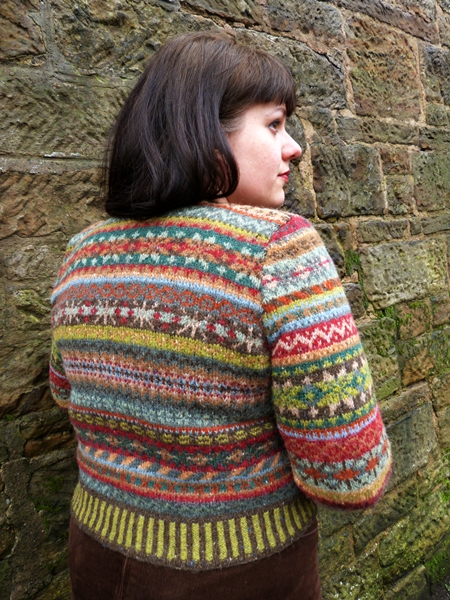
March 2014 604Oh, and I completely changed the colours.

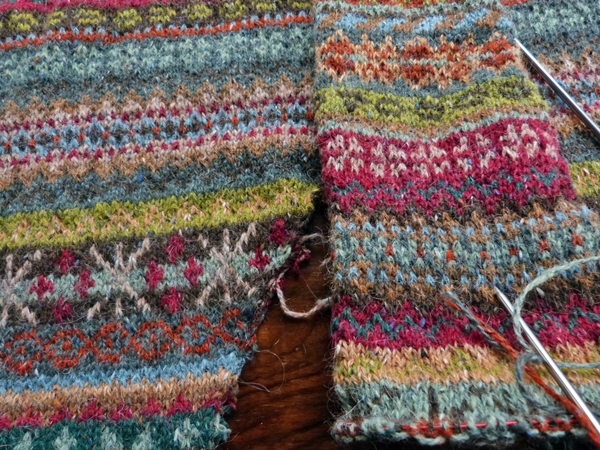
The original was quite bright when you saw it in real life and I wanted more muted colours. I started out by recharting the entire pattern using Excel. It was fairly labour intensive but it gave me an understanding of the distribution of colours and patterns. I also realised that the same sequence of patterns are used on the sleeves but knitted in different colours. If you are planning on substituting colours for Orkney, I think this is an indispensable step for understanding how the colours work and why. Tiny decisions will have a huge impact.

Having reached an understanding of which colours were used more than others, I put my Felted Tweed stash on the spare bed (reality check time!) and started sorting colours. I decided that I wanted Ancient (a blueish khaki green) to be a feature on the body with Phantom (a soft brown - one of my favourite Felted tweed colours) and Avocado (er, avocado green) for the corrugated ribs. On the sleeves I substituted Rage (a magnificent red) for whenever I had used Ancient on the body. It worked well. I also used Celadon, Ginger, Rage, Duck Egg, Gilt, Cinnamon and Camel. I used less than ball of these colours (and Avocado) but used approx 1.5 balls of Ancient, Phantom and Rage.

Would I knit this again? Oh yes. I'll go up to size XL for the sleeves but I think this is a real cracker of a pattern. I like the fit a lot better than Bute, the colours work with my entire wardrobe, and I feel good when I am wearing it. I probably won't reknit this for a few years (so many knitting patterns, so little time) but I'd love to do a brown/blue/green version of this. I have also fallen deeply in love with Felted Tweed (if I hadn't already..).

Let me just repeat what I said at the top

Verdict: Oh hell yes.
A Visit from the Knitting Police, or, On the Origins of Things

December 2013 1122 Yesterday I was working on the second sleeve of my Orkney cardigan when the following exchange happened.

Passer-by: Hey, what are you doing? Me: Oh, I'm working on this fair-isle cardigan.. Passer-by: Oh no! That's not fair-isle. You are not from Shetland. You cannot be knitting fair-isle. I am from Shetland and I am telling you that you cannot work fair-isle. Me: .. uhmm, okay?

This led to an interesting discussion on Twitter about geographical locations, if any non-Shetlanders are allowed to say their stranded colourwork is fair-isle (and if it is fair isle, Fair Isle or Fair-Isle) and if we are able to talk about "traditional knitting" at all. Here are some selected highlights:

(Great point! Can a technique or motif be geographically trademarked?) Some snarky comments from amused knitters:

And, finally, less snarkily and more to the point:

I am interested in the socio-political aspects of so-called traditional knitting: there is definitely a discussion to be had about what constitutes a tradition - who decides something is a tradition - and if we can talk about origins at all. Motifs and techniques have criss-crossed geographical boundaries and what we may think of as "traditional knitting" may only date back to the early 20th century. My personal view is that all these things only tend to be "fixed" in time and place long after actual innovation has occurred - and that many of these "fixes" have little to do with the actual innovations and more to do with money/prestige.

It's a fascinating topic and I wish I had a fresh mind with which to tackle it (alas, I am writing this after working all day on another piece of writing). I'll keep knitting my Orkney, mind. Only half a sleeve to go and I refuse to leave it alone despite my personal geographical failings.

The Cardigan is Finally Finished: Bute

March 2014 057According to my notebook, I started knitting Bute in August 2012. I finally finished yesterday. It is a strange project: I certainly did not spend 18 months working on this cardigan and the result bears very little resemblance to what I had in my head when I started out. First the facts:
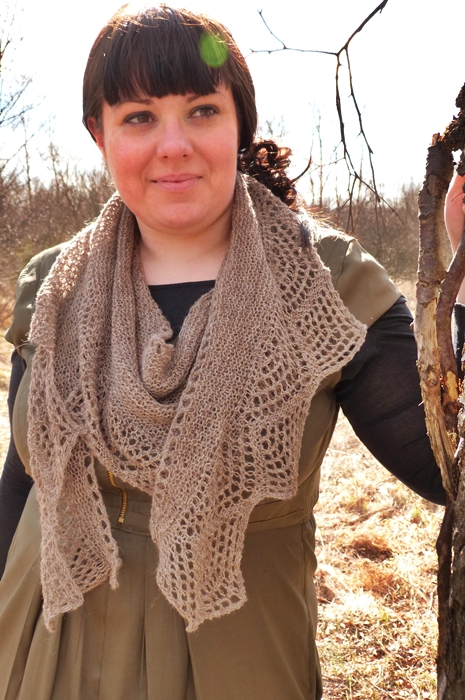
Pattern: Bute by Lisa Richardson from Rowan Magazine 52.

Yarn: Rowan Colourspun and Rowan Felted Tweed (both the suggested yarns) in Scunner, Winterburn (Colourspun) + Clay, Watery, Bilberry, Carbon and Peony (Felted Tweed).

Needles: 3.25mm and 4mm.

Size: M.

Modifications: I started out by changing the colours. I do not suit the autumnal colours of the original nor do I like the blue/yellow feel of the men's version (it's a bit too Swedish flag, really). I went down a size having tried on a shop sample. Then I chopped off a repeat of the body. I omitted the reverse sticking stitch on the shoulders.

Verdict: I loved knitting this (except when I had to reknit the front due to my own sizing mistake). I loved putting it together. I am just not sure it suits me.

Firstly, I should have gone down to size S(!) despite being on-gauge. The garment is very generously sized and it is much too big on me. Look at how the sleeve billows around my lower arm in the photo. Part of the problem is that I have lost weight since I began knitting the cardigan, but I have not lost that much weight.

March 2014 061

I have had to chop off two inches on the shoulders - the original pattern has a mild drop-shoulder effect but the shoulders were halfway down my upper arms. I am so very glad I chopped off a repeat on the body as it would have been more like a coat than a cardigan. I hope no one will ask to look at the shoulder seams after my vaguely botched surgery session with first an overlocker (which seemed like a good idea at the time) and then a crochet hook.

The sleeves are superlong too - not quite to schematic and I wish I had twigged this beforehand so I could have added a thumb hole!

Secondly, I have since learned valuable lessons about knitting garments with shape. I am a pesky hourglass shape which means I need garments to nip in at my waist or I'll drown. The Bute pattern is not to blame for my lack of self-awareness - it is just a shame that I feel a bit frumpy and enormous in the garment.

Thirdly, I do love how warm this is. I have not been cold once since I started wearing this. I may need to knit myself a fair-isle onesie in Rowan Felted Tweed (okay, maybe not) or maybe a pair of fair-isle socks (more likely). Luckily my mate Jem Weston has a pattern for a pair of very fetching fair-isle socks in the same magazines and I might make my remnants stretch for that. Hmmmm..

Lessons learned: if you try on a shop sample size XS and it's almost perfect, disregard the voices in your head and go for size S (even if you haven't been size S since primary school).

I really enjoyed knitting the "peerie" patterns and I can see myself using the stitch patterns in another project - but this time with waist-shaping.

And can I knit everything in Felted Tweed from now on? It is my new favourite yarn (fact: this is my sixth FT project in a row).

Hey! It's a Doggerland KAL with Prizes!

March 2013 443We only have two Doggerland patterns left to go, so while I get those ready, I thought it would be fun to set up a Doggerland KAL in my Ravelry group. We've been having a sort of unofficial-official KAL since the first pattern was released, but I thought it'd be fun to add prizes to the unofficial-official KAL (thus making it an official-official KAL?). I just confused myself.
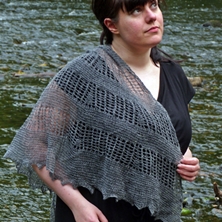
The basics: Knit a Doggerland project, post a photo in the official Doggerland KAL thread, and you can win yourself a yarny prize! On April 15, 2014, I'll draw random names and THREE lucky people will win prizes.

More basics: For every finished project, you get ONE token. The official KAL tag is "DoggerlandKAL". You can enter as many times as you'd like.

The relevant patterns are all from the Doggerland collection - they are available individually as well as a collection. You have the choice of Ronaes, Hoxne, Gillean Hat, Gillean Wristies, Ythan and Vedbaek. Any additional Doggerland patterns released before April 15, 2014 are also eligible.

Please note: if you have knitted any of the patterns knitted above - please post a photo of your finished object on the thread and tag your project. You can enter as many projects as you'd like into this KAL contest. I'll draw names at random - winner A, winner B and winner C.

June2013 019Which brings me to the fun bit. The prizes! I did think about sourcing Mesolithic lithics (worked pieces of flint) but I wasn't too sure about the ethics of removing pieces from public access. Also, I think you knitters prefer yarn. Right? Right.
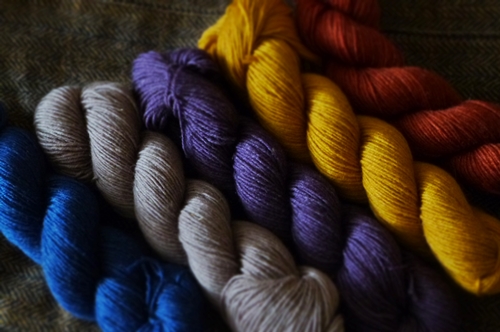
Prizes!

Winner A will win a skein of Snældan 2ply from The Island Wool Company. Seriously gorgeous yarn - it is one of my favourites - and once you start knitting with it, you won't believe the drape or feel.

Winner B will win a skein of Håndværker yarn from Hjeltholt Yarns, an artisan Danish yarn spinning mill dating back to 1878. It is the type of yarn I just love: full of depth and texture. Håndværker yarn is currently only available to a select few Scandinavian retailers, so it's a rare chance to get your hands on proper heritage artisan yarn. (I cannot believe I'm letting this go)

Winner C will win a £15 gift certificate to Old Maiden Aunt yarns. One of the best UK hand-dyers and a gift certificate means you get to choose your own favourite yarn base and colour!

Recap: Knit a Doggerland project, post a photo in the official Doggerland KAL thread, and you can win yourself a yarny prize!

Yellowed

If you follow me on Twitter, you will know that I am currently obsessing over yellow cardigans. I think it is a reaction to the winter weather we have been having. Glasgow has escaped much of the awful weather to hit Britain recently but standard Glasgow winter weather is awfully bleak. It is changeable but always some combination of rain + wind + sleet. Dreaming of yellow cardigan is thus the perfect antidote to the gloomy skies outside. Yellow cardigans and cups of tea. I am a few rows away from finishing The Thing I mentioned the other day. My plans include a hefty amount of swatching for new designs but then I am going to snuggle down and do some finishing.

January 2014 122

I finished knitting all the pieces for my Bute cardigan in late 213 but then I realised I had knitted the two front two different sizes. In my defence, I did cast on for the second front whilst working in a yarn shop so all the chatter obviously went to my head. How I did not realise my mistake when I got to the shaping at the top, I will never know. So, my plan for the weekend is to reknit the front of the cardigan. Blocking next, then sewing up and the button band. Can I finish this by the end of February? Probably not. It will take me forever to decide upon buttons.

I also want to finish knitting my Orkney cardigan (just a sleeve and a button band!) but Bute has been languishing for so long - and I really want to snuggle up in it.

Back to dreaming of yellow cardigans. I do have a cone of a beautiful mustard-yellow silk/wool aran-weight that I chanced upon some .. uhm .. four years ago. I rather like Traveller's End by the wonderful Carol Feller (classic, simple shape that'll let the yarn do the talking) but Cinnamon Girl by Amy Christoffers keeps catching my eye (I'm not sure the yarn has enough drape). Amy Herzog's Kittiwake follows in the , er, wake with its effortless cables - but I'd need to modify its shape to suit me. I do love Hallett's Ledge - so that is another contender.

Maybe I should focus on finishing Bute, then Orkney and then see where I am at with knitting deadlines. For all I know, we might be talking Easter and then yellow takes on a whole other meaning.

For the Love of Indie Dyers

ECY2014 A big thank you to Victoria of Eden Cottage Yarns for sending me this sneak peek of her new yarn, Milburn 4ply. It arrived last week and it brightened up the day. I am yet to wind any of the skeins and swatch, but I have played with colourwork patterns in my head. That oatmeal/grey colour is particularly speaking to me - I am going through a bit of a neutral phase - and I love how the other colours sing to each other. Designing a palette is always hard (every colour needs to be distinct but still play well with the others) but Vicki has pulled it off.

The UK has some of the most amazing indie dyers and I feel so fortunate that I have ready access to names like Vicki, Skein Queen (new website!), Juno Fibre Arts, Lioness Yarns, Kettle Yarn Co., Triskelion Yarns, and The Knitting Goddess. Yarn is shipped quickly and I get to see them 'live' at the various shows. Scotland is particularly strong on indie dyers: I'm a huge fan of  Old Maiden Aunt; RipplesCrafts' amazing colours are pulled from her Highland surroundings, and The Yarn Yard is well-established as a go-to dyer for sock lovers.

One of the many things I really appreciate about many UK dyers is their commitment to offering a variety of bases - many of which are UK-specific breeds. Sourcing the right bases is one of the hardest thing for an indie dyer (followed closely by being able to source enough for a sustainable business) but so many of them are now selling yarns that are so much more than just a merino or a wool/nylon mix. They are showing a real commitment to showcasing the best of British fibre - and I think this is something we should celebrate. They are small, local businesses, they are supporting other small, local businesses and knitters get to discover what makes Polwarth wool different from Corridale wool, say. Win-win for all concerned.

Louise Scollay of KnitBritish recently wrote about the Dos and Donts of Knitting Locally. It is a wonderful post which pokes holes in a lot of myths surrounding knitting locally. It does not have to be more expensive, nor is it more difficult to care for. Being thoughtful about your yarn choices is maybe something to requires a bit more mindfulness (especially next time you are in a yarn shop and are overcome with omg, all the yarn!) but it is doable and rewarding.

I'd love to see a big collaboration between indie dyers and local designers. I try to work with as many indie dyers as I can, but I am just one person. Wouldn't it be wonderful to see a plethora of the best UK indie designers collaborating with the best UK indie dyers? How do you as a knitter feel about this? What would you love to see happening within the UK indie community? And who are your favourite dyers? I know there are some dyers I am yet to discover!