Books 2010: Sarah Waters - The Little Stranger/ Rachel Seiffert: The Dark Room

My first Sarah Waters book was, appropriately enough, her first published novel, Tipping the Velvet. In 2003 I wrote: "..less than the sum of its part, but her evocation of a Victorian London filled with gender-benders and rent boys was thought-provoking: what did Dickens and his contemporaries omit from their tales?" Sarah Waters has come a long way from the seedy underbelly of Victorian London. Some would say that her books are less entertaining these days; I would say that Sarah Waters is beginning to show some impressive novelistic chops. The Little Stranger is not Waters' opus magnum. It is an uneven novel - less sure of where it is going than Waters' other novels - and the dénouement will be too open-ended for some people. I really enjoyed it, in other words. Where once Waters threw Everything and the Kitchen Sink into her books, she leans back here and trusts herself as a writer. Her first two novels were particularly unsubtle, but The Little Stranger thrives on subtlety. I understand if other readers find its lack of resolve frustrating, but I would argue this may be the point of the novel. I said it of Alan Hollinghurst and now I shall say it of Sarah Waters: the Big Important Novel will happen at some point soon. As for now The Little Stranger has preyed on my mind that Waters' other novels have failed to do.

I have not read anything else by Rachel Seiffert and the decision to read The Dark Room was a quick 8am "I have to have something to read at lunch" grab. Twelve hours later and the book is finished. Another uneven read, but unlike The Little Stranger, the unevenness stems from an author unable to join the seams and smooth out the kinks in her material. The subject, the effect of the Second World War on Germans, is too big and too complex for Seiffert. Symbolic gestures replace genuine characterisation - the disabled boy becoming a fervent nationalist; the collaborator standing in for an absent grandfather - and the entire novel falls a bit flat. I think the second story of The Dark Room's three would make a good companion piece to Markus Zusak's The Book Thief, though, as they share similar characters and a similar setting, yet tell two quite different stories.

Next: I think it is time to move away from books set circa 1940-1950.

Knitting Millbrook

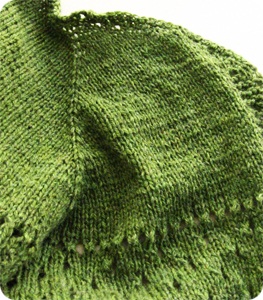
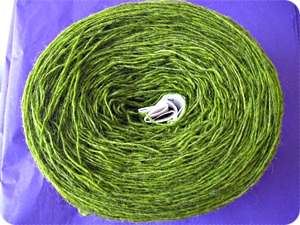
My Millbrook cardigan is technically done. I have finished knitting it, in other words, but there will be quite some finishing to do. 1. I have knitted with oiled yarn, so I am yet to see what the actual fabric will look like once the oil has been washed out (note. I did knit a swatch and washed it - but that was with another colourway one year ago). This cloud of unknowing feels quite exciting and a bit whatwasIthinking.. Right now the knitted fabric has a flimsy feel to it, but I expect/hope for the fabric to bloom.

2. I am thinking of reverting to the picot-edging used in the original pattern. The neckline feels quite bare. Last night I tried knitting a little collar and it did not look quite right. Then I crocheted an edge around the neckline which stabilised it, but still looks too bare.

3. I still have not decided on buttons (this will have to wait until I have washed the cardigan and figure out just how stable/unstable the buttonsholes are - cf. flimsy material). Currently pondering whether to crochet buttons myself.

4. And, finally, the usual flurry of finishing: weaving in ends, tightening buttonholes, blocking (as it is a lacy cardigan) etc.

    I have tried Millbrook on and it is a seriously cute, vintage-looking cardigan which is perfect for spring/summer-wear. I need to think more about what I need to have in my wardrobe and Millbrook fulfills a need I did not even realise that I had: a light woolly cardigan to wear underneath my spring/summer jacket.

    This sudden realisation that I need to knit wearable pieces stems partially from the Millbrook epiphany, but also from reading Cargo Cult Craft. Essentially a sewing blog rooted in a love of social history, Cargo Cult Craft is a thought-provoking blog with eye-candy. I am quite intrigued by its Fashion on the Ration! project:

    I’ve allotted myself 66 clothing “coupons” — the 1941 ration for each man, woman and child in Britain. Like the original, my ration will have to last me one year — from January 23, 2010 to January 22, 2011. Armed with my ration, my stash and period tips and techniques, I will maintain my everyday wardrobe while sewing a wartime wardrobe from vintage patterns and style sources.

    So far Fashion on the Ration has been a bit of an eye-opener for me, despite my initial misgivings ("gimmicky" and "bit precious"). By thinking very hard about her choice of material and what basic needs her clothes have to fulfil, the blogger is engaging with her clothes-making in a very interesting way. My favourite part? She jots down notes on what she has learned from every project. And I'm learning from her despite my craft of choice being different from hers.

    PS. I have finished reading Sarah Waters' "The Little Stranger". More on that soon.

    The Candle in the Window

    I put a lit candle on my window-sill tonight. It is a Danish tradition to do on the evening of May 4 in memory of May 4, 1945, the evening the Nazi Occupation of Denmark ended. I lit the candle in memory of family members, now long gone, who fought with the Danish Resistance. I also lit the candle thinking about democracy and the forth-coming British general election. I cannot vote in this election, and I have a sinking feeling about its likely outcome, but I appreciate living in a democracy (albeit one with a wacky voting system). I liked this little re-drawn map of Europe (and in related news, my Eurovision Pundit Podcast debút)

    And BIG, MASSIVE congratulations to the Hand-Knitted Pirate who is now Doctor Hand-Knitted Pirate.

    Books 2010: Tóibín - Brooklyn

    Last week I finished reading Colm Tóibín's Brooklyn, a quiet novel about a girl who moves from one country to another in order to improve her prospects. I have a lot of time for Tóibín: his novel about Henry James, The Master, was one of my favourite reads in the past decade, and I remember being shocked and moved by another deceptively quiet Tóibín novel,  The Story of the Night. With Tóibín, you wait for the story to hit you. His books are not fast-paced caper filled with unbridled emotions - you have to be a patient reader and put your trust in the story-telling. The quiet rooms, the things left unsaid and the thoughts the characters keep to themselves - Colm Tóibín knows that is where the real stories exist. That is not to say that Nothing Ever Happens in Brooklyn. Eilis Lacey, our protagonist, goes to dances, finds a job, meets people and falls in love. Brooklyn has comedic touches too - some colourful characters, a baseball game, a stomach-churning journey across the Atlantic - but admittedly even the comedic touches are low-key. Oh, and there are some very, very big decisions being made by ordinary people in Brooklyn.

    Brooklyn is about the the émigré experience. What does it really feel like leaving your country, your culture, your family and your friends for somewhere else? Reading Matters has an excellent take on this:

    [Brooklyn] might be set in the 1950s but it touches on universal themes that resonate today, and I've yet to read anything that so perfectly captures the profound sense of dislocation you feel when you swap one country for another and then return to your homeland for the first time.

    In short, Brooklyn is a superb paean to homesickness and the émigré experience. I think I identified with it so strongly because it shows, in an understated but powerful manner, how all emigrants have to make that god-awful decision about whether to stay or go (..).

    I took my time reading Brooklyn, mostly because I did not want to become upset on public transport or in my workplace. I hesitate to use this word, but reading this novel was a profound reading experience - I put much of myself and my own life into it. It will stay with me for a long time.

    I am now currently reading Sarah Waters' The Little Stranger. I have a little theory about Waters the novelist and so far The Little Stranger plays along with my theory. It is also very good thus far.

    Day Seven: Something About Yarn

    Fourth Edition is taking part in the Knitting & Crocheting Blog Week, and you can read more about that blog project here. I often get asked which is the best yarn I have ever used. I never know how to answer because, for me, the quality of yarn is wholly dependent upon what project I am doing. When I think about yarn, which I admittedly do all the time, I just try to think about it in context. What type of project am I making and who am I making it for? How will the object be treated, how will it be used and how often will it be used? Do I need to think about maintenance? In other words, every yarn has a purpose.

    Many knitters shudder at the thought of acrylic yarns, but I maintain they have their place in the knitting world. Knitting for young children? Acrylic yarns (or woolblends) will seem like a god-send because they can be thrown into the washing machine with nary a thought. Acrylic yarns also have a better range of colours, they will not pill as readily and certain brands will arguably withstand nuclear holocaust (or toddlers).

    I do not tend to knit for children, though, so I mostly use natural fibres. Since I live in chilly Scotland I also tend to use mostly woolly yarns.

    New Lanark Aran is one of my favourite yarns. It is locally produced, is available in some truly beautiful colours and, best of all, it knits up like a dream whilst still being affordable. Old Maiden Aunt is another guilty pleasure - she dyes beautiful sock- and lace-yarns. I adore Rowan Kidsilk Haze which has a beautiful halo and yearn for a project in Rowan Lima, a soft and complex merino/alpaca-blend.  Drops Alpaca is one of my desert island yarns. I'd happily roll around in Noro Cashmere Island.  Also, I hoard Dansk Naturfiber 1-ply kidmohair/merino because I think it may be discontinued, it is absolutely divine, and I rarely get a chance to get my clammy hands on it (I used it for my Laminaria shawl). I dream of making something out of Garthenor 1-ply. And let us not forget handspun wool - I am lucky to count some hand-spinners among friends.

    Meet the glittering star in my yarn stash firmament, though.

    This is Färgkraft SoftBlend, a 2-ply laceweight Gotland-wool handdyed using organic dyes by textile artist Margrét Kållberg for the Färgkraft co-op in Sweden. 765 yards of utter perfection.It ticks all my boxes: rustic, organic, laceweight, Scandinavian, and dyed in my favourite colour in the entire world.

    A Swedish friend of mine gave it to me last year as a birthday present. I am still trying to decide what to make from it. I feel tempted to pair it with my favourite shawl pattern, but on the other hand I also feel tempted to pair it with a traditional Scandinavian (or Nordic) shawl pattern.

    I have many, many lovely yarns in my stash thanks to friends and family, but the Färgkraft 1-ply just stands out for me. I may never actually use it, you know..

    Day Six: This Old Thing...?

    Fourth Edition is taking part in the Knitting & Crocheting Blog Week, and you can read more about that blog project here. When I look back upon all the things I have knitted in the last, say, six months, there is one item I have worn more often than anything else: my Art Deco shawl.

    The shawl is not knitted out of fancy, expensive yarn - just an ordinary DK woolblend which I found at a favourable price - but it has earned its keep many times over these past few months. You see, the shawl quickly turned itself into a big, cosy scarf/shawl/blanket which kept me warm during the hardest winter in Scotland for over thirty years. When it snowed, I could pull it halfway over my face; when I was cold at night I'd drape it across my legs. Now we have finally seen the arrival of spring, it still warms my shoulders and acts as a nice buffer between me and the wind.

    Oh, and the colours never failed to cheer me up.

    So, how does it look now?

    Well-loved, it is certainly not as crisp as it used to be. Actually, just looking at that photo I feel like giving the shawl a good soak and setting up a date with some blocking pins. However, the wool is wearing very well (yes, that would be the acrylic content, I bet) and it is as warm and cosy as ever.

    In fact, I think I'll just keep it wrapped around my neck.

    Mmmm.

    Toasty.

    (I apologise for the haggard look. I'm just home from work)